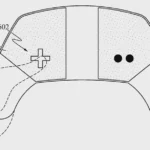
The patent, describes a PlayStation-style controller that eliminates physical buttons, joysticks, and D-pads in favor of large touch-sensitive input surfaces detected by underlying optical sensors. Here’s a diagram from the patent (FIG.) showing the controller’s adaptive virtual controls, including a D-pad (cross), action buttons (circles), and thumbstick areas that shift based on hand grip.
Key Features from the Patent
Input Detection: Optical sensors under an optically transmissive surface detect touch, tap, swipe, press, pinch, joystick gestures, and even “pretouch” (finger approaching the surface before contact).
Customization: Virtual buttons/locations are user-configurable—resize, reposition, or remove them for hand size, accessibility, or game-specific needs (e.g., one giant jump button).
Adaptivity: Automatically adjusts layout based on grip detection; recognizes users via fingerprints or patterns and loads saved profiles.
Feedback: Haptic, deformable surfaces, or illumination to “feel” or see button locations; optional pressure/heat sensors distinguish rests from presses.
Advantages Cited: Overcomes fixed layouts in traditional controllers that don’t fit all hands; reduces size/cost; enables modular, accessible designs.
Key Quote from Patent: “According to embodiments, a buttonless game controller input configuration is provided… Input surfaces of the controller may be configured to detect user touch and user inputs similar to activation of a button or manipulation of a directional pad without requiring actual push buttons or a directional pad.”
Sony files hundreds of patents yearly—most never become products—but this one’s recent grant has fueled speculation about future DualSense evolutions or accessibility-focused hardware.